
Survision is proud to announce the release of the new EXA models (Edge Extreme Accelerator) for its Generation 5 Micropak and Visipak product lines.
The EXA models introduce an embedded AI accelerator directly within the camera, complementing the existing CPU architecture and significantly increasing AI and Deep Learning processing capacity. This enhancement enables larger and more complex AI models to run directly at the edge, delivering faster and more advanced vehicle recognition capabilities without relying on external processing resources.
With the EXA upgrade, Survision continues its commitment to innovation in intelligent vehicle identification technologies, providing customers with enhanced performance, scalability, and future-ready AI capabilities.
Key Performance Benefits
The EXA platform is designed to improve recognition performance in real-world conditions while delivering faster and more reliable results.
- Better reads on non-reflective, dirty, and angled license plates
- More accurate confidence levels for improved decision-making
- Ultra-fast processing speeds
- Increased capacity for advanced AI and Deep Learning models
- Enhanced edge processing capabilities
What Makes EXA Different?
As AI models continue to evolve, they require greater processing power to deliver higher levels of accuracy and functionality. The EXA platform addresses this need by integrating a dedicated AI accelerator directly into the camera, enabling advanced Deep Learning models to operate at the edge without compromising performance.
By processing data closer to the source, EXA cameras can make faster decisions, reduce network traffic, and minimize reliance on centralized servers. This allows organizations to deploy more intelligent vehicle recognition systems while simplifying infrastructure requirements.
How EXA Cameras Can
Improve Your Operations
Faster Processing Speeds
Process vehicle data faster, enabling near real-time vehicle identification and response.
Improved Accuracy
Run larger and more advanced AI models that can better identify vehicles and license plates across a wider range of conditions, including dirty, damaged, non-reflective, and angled plates.
Reduced Latency
By minimizing the need to transmit data to external systems for processing, EXA cameras deliver results faster and more efficiently.
Enhanced Edge Computing Capabilities
Perform more complex AI tasks directly within the camera, reducing infrastructure requirements and increasing system resilience.
Future-Ready Platform
With increased AI processing capacity, EXA is designed to support the next generation of vehicle recognition capabilities as AI models continue to evolve.
Ideal Applications
EXA models are well suited for a wide range of vehicle identification applications, including:
- Parking management
- Access control
- Tolling systems
- Smart city deployments
- Traffic monitoring
- Law enforcement applications
- Logistics and fleet operations
Driving the Next Generation of Vehicle Recognition
The introduction of EXA marks another step forward in Survision's mission to deliver innovative vehicle identification solutions that combine accuracy, performance, and scalability.
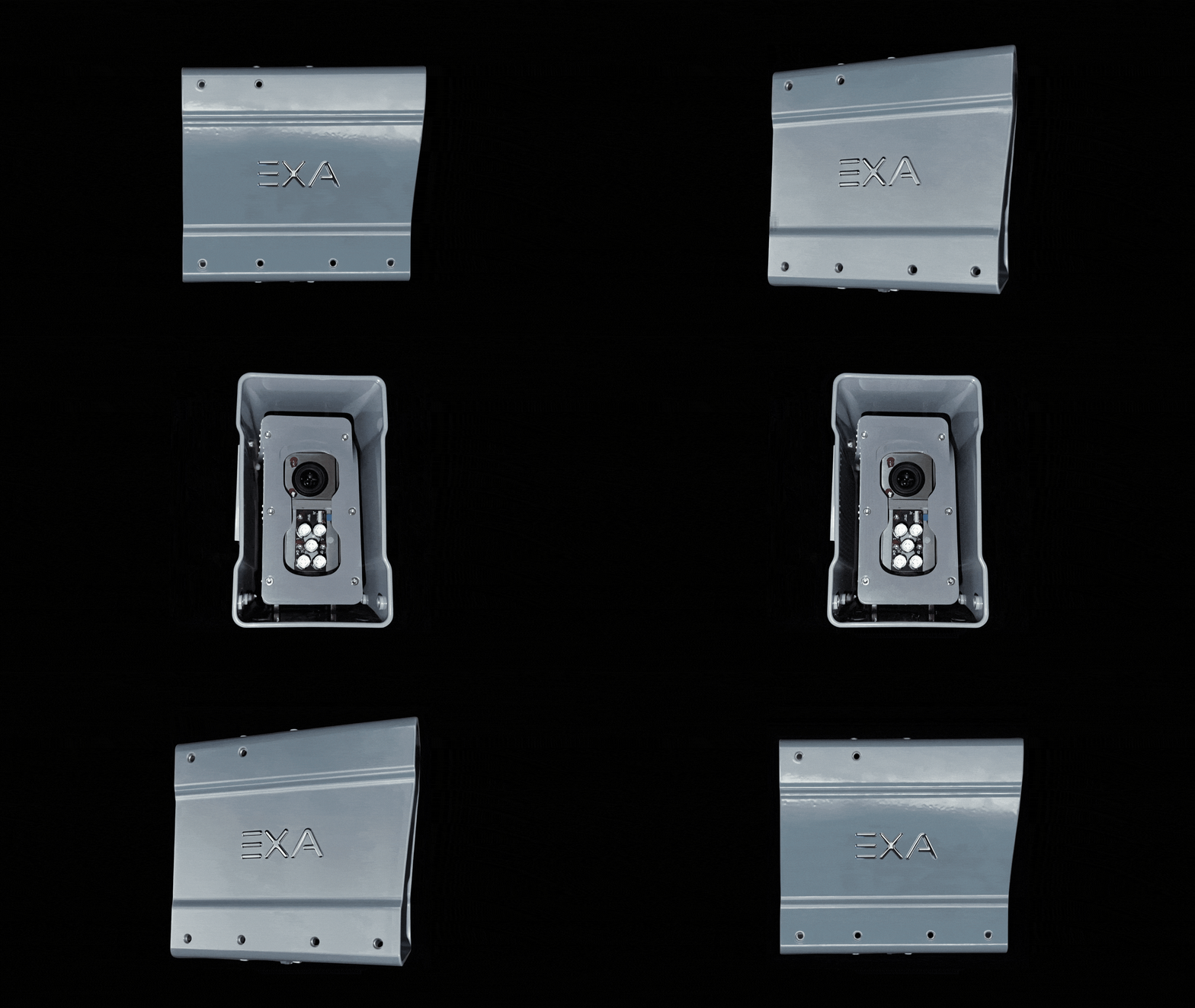
By bringing greater AI processing power directly into the camera, EXA enables faster recognition, improved accuracy, and support for increasingly sophisticated AI models—all while reducing infrastructure requirements and maximizing the value of edge computing.
The future of vehicle recognition is at the edge, and EXA is built to power it.
Ready to Learn More About EXA?
Discover how the new EXA models can help improve recognition performance, reduce latency, and unlock more advanced AI capabilities at the edge.
Contact the Survision team to learn more about EXA and discuss the right solution for your vehicle identification application.
FAQ
EXA (Edge Extreme Accelerator) is Survision's new embedded AI acceleration platform available on Generation 5 Micropak and Visipak cameras. It adds dedicated AI processing power directly within the camera, enabling more advanced Deep Learning models to run at the edge.
EXA delivers:
- Better reads on non-reflective, dirty, and angled license plates
- More accurate confidence levels
- Faster processing speeds
- Enhanced edge AI capabilities
The additional AI processing capacity allows more sophisticated Deep Learning models to operate directly within the camera. This improves recognition accuracy in challenging real-world conditions, including poor lighting, dirty plates, difficult viewing angles, and non-reflective plate materials.
No. The AI accelerator is embedded directly within the EXA camera models, providing increased processing capabilities without requiring external AI processing hardware.
Yes. EXA is designed to perform advanced AI processing directly at the edge, minimizing latency.
EXA delivers faster processing speeds, enabling near real-time vehicle identification and response.
EXA is ideal for:
- Parking management
- Access control
- Tolling systems
- Smart city deployments
- Traffic monitoring
- Law enforcement
- Logistics and fleet management
Non-reflective, dirty, damaged, and angled plates.
Yes. The increased AI processing capacity of EXA is designed to support larger and more advanced Deep Learning models, helping customers benefit from future innovations in vehicle identification technology.
No. It maintains the same API, physical dimensions, connectors, and installation process as current Survision cameras, making it easy to adopt enhanced AI performance.
EXA is currently available on Survision’s Generation 5 Micropak and Visipak product lines. As part of our ongoing product roadmap, EXA will be introduced across the remainder of the Survision portfolio in future releases.