
by Jacques Jouannais, CEO of Survision
Automated License Plate Recognition (ALPR/ANPR) has become an essential tool for vehicle identification and tracking in most European countires.
While front plate reading has historically been preferred, rear plate reading has long remained a more complex and less efficient alternative.
Why is that? And more importantly, why is this no longer really the case today?
Automated License Plate Recognition has become, over the past 20 years and even more so in recent years, an essential technological tool for vehicle identification and tracking for parking and highway operators, police forces, cities, airports, universities, and more.
Historically, cameras were deployed primarily at the front of vehicles due to their superior performance on front license plates.
This is mainly due to four key characteristics:
In areas controlled by barriers, these barriers separate vehicles, allowing for better license plate visibility, especially when the vehicle is stationary, thus maintaining a consistent position in space.
The sequencing provided by the barriers facilitates easier synchronization with other potentially present systems (vehicle classification, fraud detection, etc.).
Front license plates, mounted on the vehicle's grille, are clearly visible and offer a more favorable signal-to-noise ratio, particularly in the absence of other interference or obstructions from the plates themselves.
The possibilities for mounting front-facing license plate sensors are more varied, including the option of a certain distance between the cameras and the plates, thus reducing the detection angles.
Rear license plates, on the other hand:
Must be read on the fly because a vehicle's length varies and the barrier makes it difficult to accurately position the plate.
Are often obscured by the vehicle following the one being monitored.
Are generally recessed into the vehicle's chassis, creating various problems that impair their visibility: shadows cast by the chassis on the plate, partial or total obscuration by overhanging chassis components on commercial vehicles or tow balls on private vehicles, etc.
They are generally in poorer condition and dirtier.
On heavy goods vehicles, numerous interference signals are present at the rear and hinder the accurate reading of license plates (speed limits, various markings, etc.).
By definition, reading from the rear requires a very short-range focus, and therefore very steep angles, firstly to avoid obscuring the view from the following vehicle, and secondly because placing too much distance between the camera and the vehicles at the site entrance would necessitate positioning the camera outside the site, potentially in an area not belonging to the operator.
This very short-range reading at steep angles is necessarily performed on the fly and therefore on a much smaller number of images than with front-facing license plates.
The angles also introduce specific constraints related to the distortion of the characters and the difficulty of illuminating the plates evenly at night.
Finally, synchronization with other devices present on the traffic lanes becomes particularly complex and inefficient.
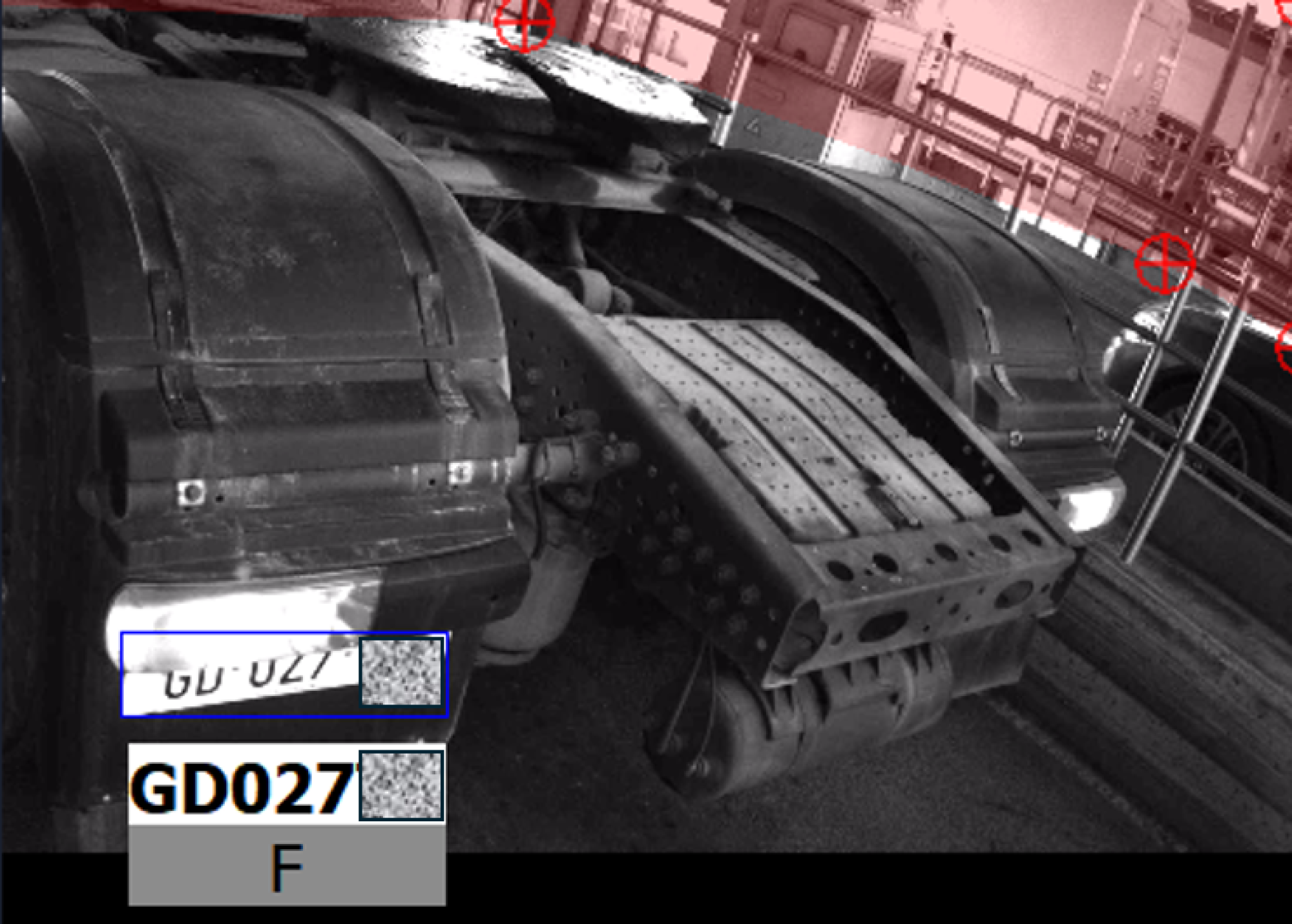
Illustration of the specific difficulties in reading license plates from the rear and the performance achieved despite these challenges thanks to the new generation SURVISION ANPR sensors (plate read correctly, but characters masked to prevent vehicle identification).
For all these reasons, the preferred placement has always been on the front, and reading rear plates has only been used when operational constraints left no other option. These constraints were generally unavoidable and resulted from factors beyond the operators' control:
Jurisdictions not requiring front plates, as in most US states.
The need to monitor motorcycles.
The need to monitor truck trailers in addition to tractors.
Consequently, while a standard front-mounted ANPR (Automatic Number Plate Recognition) sensor offered very high performance, rear-mounted installations long exhibited variable but always significant underperformance (depending in particular on the proportion of trucks and motorcycles). This underperformance particularly hampered the use of ANPR technology in countries where vehicles are only equipped with rear license plates.
This major obstacle to the development of these technologies, so useful for a wide range of sites and professions, is disappearing thanks to advancements in ANPR technology.
SURVISION, recognizing the difficulties its clients encountered with rear-mounted ANPR systems, especially parking lot and highway operators, has developed a technology in recent years that allows for rear-mounted installations (with the associated constraints) without sacrificing performance. The combination of cameras allowing for very short-range physical deployment, thanks to adapted optical choices, the adoption of processing power enabling much more advanced AI technologies, and above all, the development of AI models specifically adapted to the constraints of rear license plate recognition (limited images, extreme distortions, and numerous visual disturbances) has led to a dramatic improvement in rear license plate recognition performance.
The "EXA" model of SURVISION's Generation 5 cameras, launched in spring 2026, is the result of this research and finally allows operators to benefit from performance similar to that achieved with front-facing cameras when their installations require the rear-facing ANPR cameras. A small revolution in the world of ANPR and very good news, especially for countries where installing cameras only at the front is not a viable option.
| Standard model | EXA model | |
|---|---|---|
| Detection Rate | 97,37% | 98,77% |
| Plate Read Accuracy | 94,20% | 98,08% |
Comparison of ANPR performance between a standard camera and an EXA camera, mounted on the rear, with extreme angles, at very short range, in a toll lane (France, with a high proportion of vehicles from other countries).
But these technological improvements also find particularly relevant applications when operational requirements are such that vehicle identification performance close to 100% must be achieved, especially for ticketless or even barrier-free installations. The combined use of a standard front camera and a short-range EXA rear camera makes it possible to approach this ultimate goal, on which the economics of free-flow installations depend, as demonstrated by recent tests carried out by SURVISION on motorway installations.
| Front camera alone | Rear EXA camera alone | Front and rear cameras combined | |
|---|---|---|---|
| Detection Rate | 99,72% | 98,77% | 100% |
| Plate Read Accuracy | 98,90% | 98,08% | 100% |
Comparison of ANPR performance in front-only, rear-only and combining both readings, in a toll lane (France, with a high proportion of vehicles from other countries).
Rear plate recognition, long considered a secondary option in Europe due to significant technical constraints, has now become a fully viable alternative thanks to recent advances in sensor technology and artificial intelligence.
It is now paving the way for new use cases and more flexible system architectures, while achieving performance levels comparable to, and even complementary with, front plate recognition.
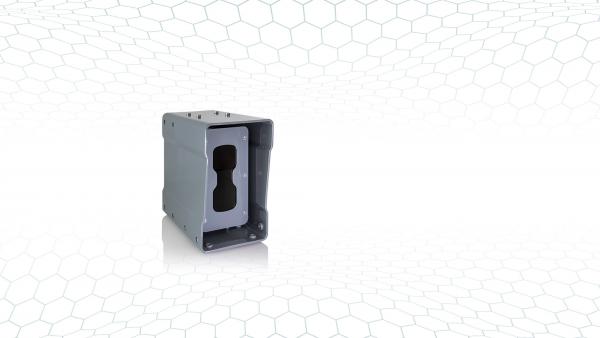
High performance LPR camera for the most challenging sites such as very short distances and open angles

More affordable, smaller yet very fast and precise LPR camera, ideal for barrier or totem embedding
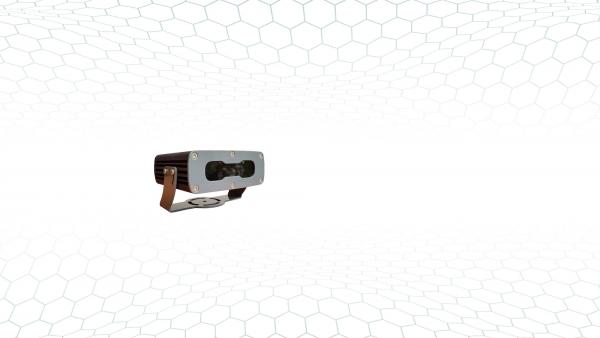
The world's smallest LPR camera for security and on-street parking control

Ideal for ITS and Tolling, this powerful camera works at large distances and very high speeds

Compact and affordable LPR camera with 4G connection, designed for Smart city
Despite the country or region, even Vanity Plates!
Lights, protection and connection are integrated into the LPR Cameras
LPR is performed in the LPR cameras firmware
LPR can be triggered by external device or by the license plate itself
Neural networks are used to learn from every plate read and increase performance over time
Up to 155 mph (250 km/h)
The shortest distance (from 5ft!) at the highest accurate reading speed (20ms)
You do not need more than 1 Survision LPR camera to get LPR working
Software tools for system integration or app building

Give us a call; we can help. No question is too big. We love to talk about even the smallest details when it comes to LPR. We've got answers for you. Our expert team is a great resource for information, just a phone call away.